
Sending Gifts Overseas from Pleasanton: What to Expect
Shipping gifts and parcels abroad from Pleasanton this season? What to know about restricted items, duties, food, batteries and customs paperwork before you pack.
There is a stretch of the year, starting around September and running to the new year, when the same errand keeps turning up at the counter: a box that has to reach someone far away, by a date that actually matters to somebody.
The occasions are not the same. A family sending sweets and new clothes ahead of Navratri and Diwali. A daughter mailing a Thanksgiving parcel to parents who could not travel this year. Grandparents getting Christmas presents to grandchildren on the other side of an ocean. Different households, different months, different reasons — and, almost every time, the same box, the same counter, and the same handful of questions.
This is a plain description of what makes those parcels complicated, so you can prepare before you pack rather than at the counter with tape in your hand.

✈️ The parcel is the easy part. The border is not.
Getting a box from Pleasanton to an airport is routine. What decides whether it arrives is what is inside it and where it is going — and those two things interact. An item that travels without comment to one country is held at another. The rules belong to the destination, not to the carrier and not to us, and they are revised more often than most people expect.
So there is no universal list to memorise. There is only the list for your destination, as it stands right now. Each carrier publishes its own, and the postal system publishes country-by-country guidance:
- USPS Individual Country Listings — what a specific destination will and will not accept by mail
- USPS international shipping restrictions
- UPS special-care and regulated items
- FedEx prohibited and restricted items
⚠️ We are not customs brokers, and nothing here is a ruling. What we can do is look up the current requirement for your destination with you, at the counter, before the box is sealed.
💸 Duties are paid by the person opening the box
This is the one that spoils gifts, and it is worth saying clearly: in most cases the import duty or tax is charged to the recipient, not to you. Somebody who was expecting a present is instead asked for money before they can collect it.
How much, and whether anything is owed at all, is set by the destination country and depends on what you sent and what it is worth. The carriers explain the mechanics — FedEx has a reasonable overview of how duties and taxes are calculated — but the authority is the destination's own customs service.
The practical move is not to guess the number. It is to decide, before you ship, who is paying it, and to tell the person receiving the parcel that a charge may come. A five-second heads-up is the difference between a nice surprise and an awkward one.
Food and sweets carry their own layer
Mithai, snacks, dry mixes, homemade anything — food is treated as its own category almost everywhere, on top of whatever the general rules are. Perishability, ingredients, packaging and labelling all come into it, and destinations differ widely in what they will let through.
Bring the item, or a photo of its label, and we will check what your destination allows before it goes in the box. Sealed and labelled is a different conversation from a tin packed at home — and better had before you have wrapped it.
Electronics and anything with a battery
Batteries are regulated as a safety matter, separately from customs, and the rules travel with the item rather than the destination. The thing to watch is how the battery is packed — sitting inside the device it powers, or loose in the box alongside it — because that changes what is permitted and which carriers will take it at all.
If your parcel holds a phone, tablet, toy, power bank or anything that charges, say so when you come in. It is the most common reason a gift box gets repacked.
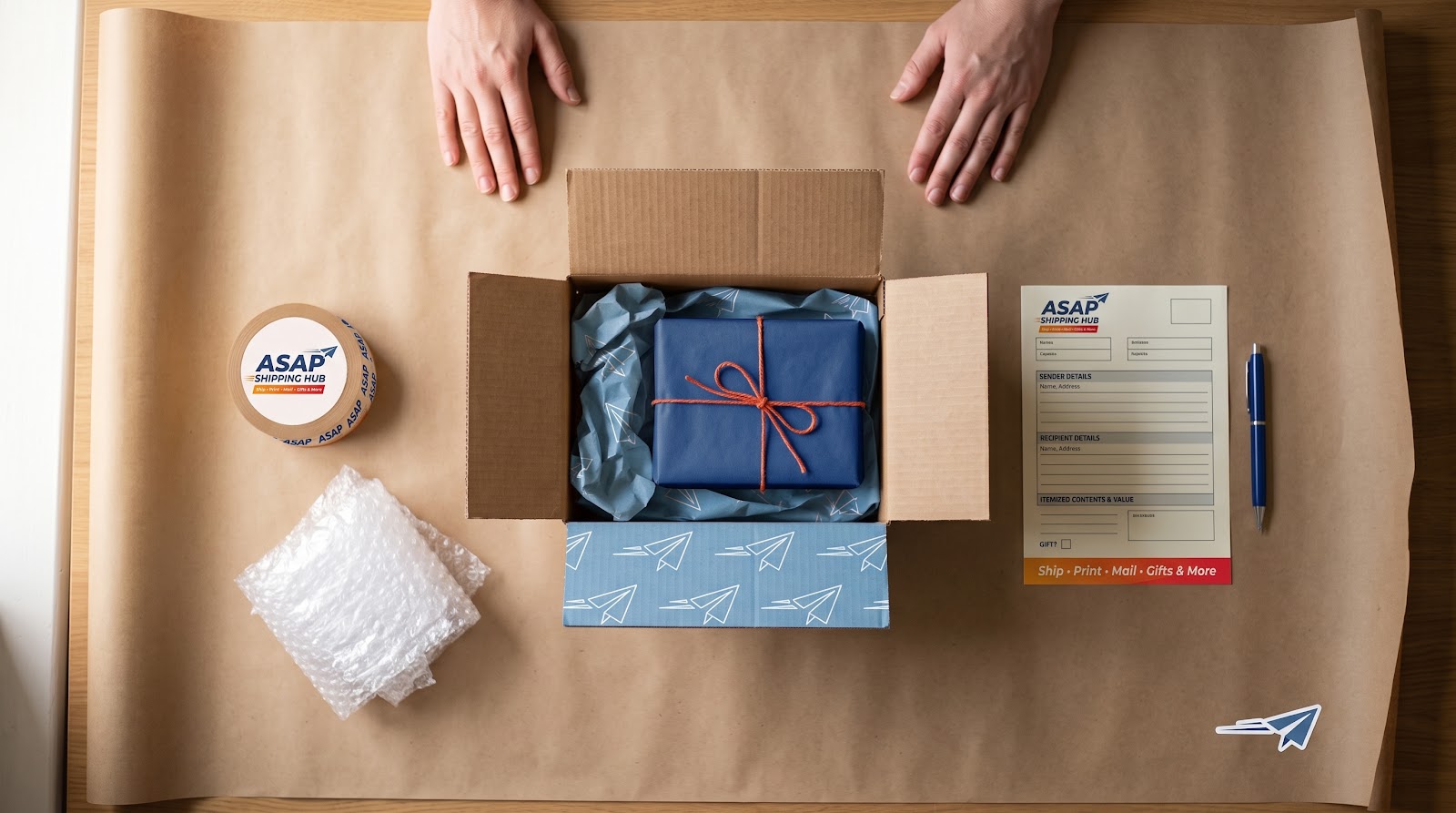
📄 A gift and a shipment are not the same paperwork
How a parcel is declared changes how it is processed. A personal gift, an item you sold, and commercial samples are three different things on a customs form, and the destination treats them differently — sometimes very differently.
Two things matter more than people expect. The description: "gift" tells customs nothing, while an honest itemised list keeps the box moving. And the declared value: understating it to shrink the recipient's duty is the shortcut that most often ends with a parcel held, opened or returned — and the delay usually costs more than the duty would have.
What we actually do at the counter
We compare USPS, UPS and FedEx for each individual parcel. There is no single carrier that is right for every destination — the best option changes with where it is going, how big and heavy it is, how fast it needs to arrive, and what is inside. For some destinations the right answer sits outside those three, and we will tell you if that is the case for yours.
Alongside that, we look up the current restrictions for your destination and help you write a customs description that survives an inspector reading it. If something in the box is going to be a problem, you hear it from us while there is still time to act.
You are welcome to bring a parcel already packed and sealed — we will ship it as it is. If you would rather not wrestle with bubble wrap, we also pack for you as a paid service, which is the sensible option for glass, ceramics, framed pieces and anything else that will not forgive a rough transfer.
📦 Before you come in
- Have the complete address. Including postal code and a working phone number for the recipient — carriers and customs use it, and a missing phone number stalls parcels.
- Know what is in the box, item by item. Not "gifts". The actual contents, and roughly what each is worth.
- Flag food, liquids and batteries. These are the three that change the answer.
- Decide who is paying any duty, and tell the person receiving it.
- Come earlier than feels necessary. This season gets busier every week, and carrier cutoffs are published closer to the holidays. Early parcels have room to absorb a problem; late ones do not.
🕒 The size of the window you are shipping into
It helps to know what your box is joining. Between mid-November and early January last season, USPS reported handling 16 billion mail items and packages, delivered in 2.5 days on average — faster than the 2.8 days it recorded the season before, across a network reaching more than 170 million addresses. The same release notes something easy to forget while taping a box shut: the Postal Service is in its 250th year.
Two things are worth taking from that. The system does cope at this scale, so the December panic about parcels vanishing is mostly unearned. But those averages are domestic. An international parcel adds a customs step that no domestic package goes through, and that step is the one nobody publishes an average for — because it depends on your destination, your contents and your paperwork. That is the whole argument for going early.
We are the counter down the road
Most parcels that leave here are not commercial freight. They are one family sending something to another, and whoever packs the box knows exactly who opens it. That is a different job from moving pallets, and the one we set the shop up to do.
📦 Know someone in the Tri-Valley who does the family shipping every year? Send them this page. Half the problems above are avoidable, and every one of them is easier to fix in September than in December.
If you would rather sort out the questions before you pack, bring the items in and we will go through them with you.